
Sprint Triathlon Distances: A Complete Guide in Miles and Meters
A standard sprint triathlon is a 750-meter swim, a 20-kilometer bike, and a 5-kilometer run. In miles, that is a 0.47-mile swim, a 12.4-mile ride, and a 3.1-mile run, about 16 miles of racing in total. Most first-timers finish somewhere between 1 hour 15 minutes and 1 hour 45 minutes.
That is the short answer. The longer answer is the part that actually helps you get to the start line: how far each leg really feels, what a super sprint changes, how sprint compares to Olympic and Ironman distances, and what it all looks like when the swim is a Colorado reservoir at 6,000 feet.
We are a triathlon shop in Arvada, and we have watched a lot of people go from “I think I could maybe do one of these” to crossing a finish line. The distances are almost never the hard part. Not knowing what to expect is.
Sprint triathlon distances at a glance
| Leg | Metric | Miles | Roughly equivalent to |
|---|---|---|---|
| Swim | 750 m | 0.47 mi | 30 lengths of a 25-yard pool |
| Bike | 20 km | 12.4 mi | A 45-minute spin class, outdoors |
| Run | 5 km | 3.1 mi | A parkrun or a lap of a large park |
| Total | 25.75 km | 16 mi |
Those are the USA Triathlon standard sprint distances, and most races in Colorado and nationally stick to them. Some do not. Pool-swim sprints often run 400 or 500 yards instead of 750 meters, and a point-to-point course may stretch the bike to 13 or 14 miles to fit the roads. Always read the race page rather than assuming.
The swim: 750 meters (0.47 miles)
This is the leg that scares people, and it is the shortest one. Seven hundred and fifty meters is under half a mile. In a 25-yard pool it is 30 lengths. A swimmer with no background who trains twice a week for eight weeks can cover it comfortably.
What makes it feel different is the open water. There are no walls to push off, no black line to follow, and 200 other people starting at the same time. The fix is not fitness. It is practice. Two or three open-water sessions before race day changes everything.
Sighting is the skill that matters most. Every six to eight strokes, lift your eyes just above the surface to spot the next buoy, then drop back into your stroke. Swimmers who do not sight routinely swim 850 or 900 meters on a 750-meter course, which is a slower swim caused entirely by navigation.
Most Colorado sprints are wetsuit-legal. USA Triathlon allows wetsuits for age-group athletes when the water is 78°F or cooler, and Front Range reservoirs are typically in the low-to-mid 60s through June and into the low 70s by August. A wetsuit adds buoyancy, which lifts your hips, which makes you faster and calmer. If you are racing more than once a season, buying is worth it. We stock Orca and blueseventy wetsuits. If this is your only race this year, rent one for the season and put the money toward a bike fit instead. Either way, get a pair of goggles that seals properly and swim in them at least twice before race day.
The bike: 20 kilometers (12.4 miles)
Twelve and a half miles on whatever bike you own. This is the single biggest misconception about sprint triathlon: people wait to sign up until they can afford a triathlon bike. Do not. A road bike is fine. A gravel bike is fine. A hybrid with the tires pumped up is fine, and we have seen plenty of them finish.
What matters far more than the bike is how you fit on it. A well-fitted road bike beats a badly fitted tri bike at every distance, and at sprint distance the aerodynamic advantage of a dedicated tri bike is measured in a couple of minutes. Comfort, on the other hand, determines whether you get off the bike ready to run or ready to quit. If you already own a bike, a professional bike fit is the highest-value thing you can do before your first race. If you are buying one, start with our bike size chart to get the frame size right.
Expect the ride to take 35 to 50 minutes for most riders. Two habits will save you more time than any equipment purchase: practice drinking from your bottle while moving, and practice getting your feet out of your shoes before the dismount line.
The run: 5 kilometers (3.1 miles)
A 5K, run on legs that have just spent 45 minutes cycling. That last part is the whole story. The sensation is well known enough to have a name, jelly legs, and it comes from your muscles switching abruptly from a fixed, seated pedal stroke to a weight-bearing stride. It lasts somewhere between half a mile and a mile, and then it passes.
Brick workouts are the answer. Ride, then immediately run for 10 to 15 minutes. Do it four or five times before race day and the sensation stops being a surprise. Start the run 30 seconds per mile slower than your standalone 5K pace and let the legs come back to you. Nearly everyone who blows up on a sprint run did it in the first half mile.
What is a super sprint triathlon?
A super sprint is roughly half a sprint: typically a 400-meter swim, a 10-kilometer bike, and a 2.5-kilometer run. In miles, that is a 0.25-mile swim, a 6.2-mile ride, and a 1.55-mile run. Most people finish in 35 to 60 minutes.
Super sprint distances vary more between races than any other format, so check the specific event. Some use a 300-meter pool swim; some run a full 5K off a shorter bike.
It is an excellent first race. You get the full experience, the mass start, the transitions, the finish chute, at a distance you can complete on very little training. Plenty of athletes do a super sprint in May and a sprint in August, and that progression works well.
How long does a sprint triathlon take?
Total time including both transitions, for the standard 750 / 20 / 5 distances:
| Athlete | Finish time | What that looks like |
|---|---|---|
| First-timer | 1:30 to 1:45 | Steady effort, walks an aid station, enjoys it |
| Recreational | 1:15 to 1:30 | A season or two of consistent training |
| Competitive age-grouper | 1:05 to 1:15 | Structured training, fast transitions |
| Front of the race | Under 1:05 | Podium contention at most regional races |
Transitions are the overlooked variable. T1 and T2 together take a first-timer four to six minutes and an experienced racer under two. That is a three-minute gap available for free, without a single extra training session, which is why setting up your transition area the same way every time is worth practicing in your driveway.
How sprint compares to every other triathlon distance
Sprint sits second from the bottom in a ladder of five standard formats. Here is the full picture:
| Format | Swim | Bike | Run | Total |
|---|---|---|---|---|
| Super sprint | 400 m / 0.25 mi | 10 km / 6.2 mi | 2.5 km / 1.6 mi | 8 mi |
| Sprint | 750 m / 0.47 mi | 20 km / 12.4 mi | 5 km / 3.1 mi | 16 mi |
| Olympic | 1.5 km / 0.93 mi | 40 km / 24.8 mi | 10 km / 6.2 mi | 32 mi |
| Half / 70.3 | 1.9 km / 1.2 mi | 90 km / 56 mi | 21.1 km / 13.1 mi | 70.3 mi |
| Full / Ironman | 3.8 km / 2.4 mi | 180 km / 112 mi | 42.2 km / 26.2 mi | 140.6 mi |
Olympic distance is exactly double a sprint in every leg, which makes it the natural next step. Most athletes who enjoy their first sprint move to Olympic within a year or two. The jump from Olympic to 70.3 is a much bigger commitment: the bike alone more than doubles, and training moves from hours a week to most of a weekend.
There is no shame in staying at sprint distance forever. Plenty of the strongest athletes who come through our door race sprints exclusively because they are fast, competitive, and do not consume an entire season.
Racing a sprint triathlon in Colorado
Three things make racing here different from racing at sea level.
Altitude. Front Range races run between roughly 5,000 and 7,000 feet. Expect your heart rate to sit higher at the same effort and your run pace to be slower than your flatland times. Race by effort, not by watch, and drink more than you think you need. You lose fluid faster in dry mountain air without noticing.
Cold water. Reservoir swims at Chatfield, Aurora, Union, Boulder, and Grand Lake sit well below ocean temperatures. Early-season races can start in water in the high 50s. Get in the water before the gun so the cold-shock gasp happens during your warm-up rather than 100 meters into the swim.
A short season. The Colorado triathlon calendar runs roughly May through September, with the densest stretch in July and August. That compressed window means races fill quickly, so register earlier than you would elsewhere.
We keep a current Colorado triathlon calendar with the sprint-distance races across the Front Range, which is the fastest way to find a first race that fits your timeline.
What you actually need for your first sprint
Honestly, less than the internet suggests. Here is the short list:
- A bike that works and brakes properly. Any bike. Get it tuned, not replaced.
- A helmet that fits. Non-negotiable: you will not be allowed to start without one.
- Goggles that seal, tested in advance.
- A wetsuit, bought or rented, for almost any Colorado open-water swim.
- Something you can swim, bike, and run in without changing. A tri kit is ideal; a snug pair of shorts and a technical top works.
- Running shoes you have already put miles on. Race day is not the day for new shoes.
- One bottle of sports drink and one gel. At sprint distance, nutrition is simple: hydrate on the bike, take a gel if the run feels long, and do not experiment with anything new. Our gels and electrolytes shelf is worth a browse for anything you have not tried.
Things you do not need for a first sprint: a triathlon bike, a power meter, race wheels, or a fourth pair of goggles. If you are traveling to a destination race later on, a bike travel case rental is far cheaper than buying one for a single trip.
Frequently asked questions
How long is a sprint triathlon in miles?
About 16 miles total: a 0.47-mile swim, a 12.4-mile bike, and a 3.1-mile run.
How far is the swim in a sprint triathlon?
750 meters, or 0.47 miles, roughly 30 lengths of a 25-yard pool. Some pool-based sprints shorten this to 400 or 500 yards.
Do I need a wetsuit for a sprint triathlon?
For open-water races in Colorado, almost certainly. USA Triathlon permits wetsuits for age-group athletes at 78°F and below, and Front Range reservoirs are comfortably under that for most of the season. Buying makes sense if you plan to race repeatedly; otherwise renting for the season costs a fraction of that.
Do I need a triathlon bike?
No. At 12.4 miles the time difference between a well-fitted road bike and a tri bike is a couple of minutes. Spend the money on a bike fit for the bike you already own.
Is a sprint triathlon hard for a beginner?
It is challenging but very achievable. Most people who can already swim a few lengths, ride a bike for 45 minutes, and jog a couple of miles can be ready in eight to twelve weeks of training three or four times a week.
What is the difference between a sprint and a super sprint?
A super sprint is roughly half the distance: typically 400 m swim, 10 km bike, 2.5 km run, versus 750 m, 20 km, and 5 km for a sprint.
How long does a sprint triathlon take?
Most first-timers finish in 1:30 to 1:45. Experienced age-groupers come in between 1:05 and 1:30, including transitions.
Ready to pick a race?
Sprint distance is the best entry point in the sport: short enough to train for around a job, long enough that finishing means something.
Have a look at the Colorado triathlon calendar, choose a race eight to twelve weeks out, and register today. Signing up is the part that makes the training happen.
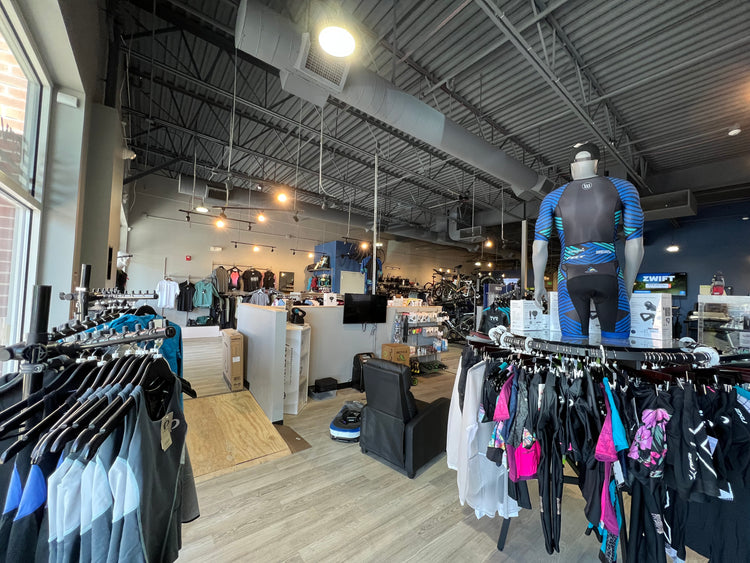
If you want a hand with the gear, come see us. We are at 14715 W 64th Ave, Unit D in Arvada, and we will happily talk you through what you need and, more usefully, what you do not.
Location
Arvada Triathlon Company
14715 W 64th Ave, Unit D
Arvada, CO 80004
Monday 10am-4pm
Tuesday-Saturday 10am-6pm
Sunday 12pm-4pm